For many people going through cancer treatment, chemotherapy brings a difficult contradiction. The treatment may extend your life. But it can also leave lasting effects on your body and nervous system. One of the most difficult is chemotherapy-induced peripheral neuropathy, also called CIPN. It can cause burning pain, tingling, numbness, sensitivity to cold, loss of …

For many people going through cancer treatment, chemotherapy brings a difficult contradiction. The treatment may extend your life. But it can also leave lasting effects on your body and nervous system.
One of the most difficult is chemotherapy-induced peripheral neuropathy, also called CIPN. It can cause burning pain, tingling, numbness, sensitivity to cold, loss of sensation and problems with balance or movement. And for some people, these symptoms do not disappear when chemotherapy ends. They can continue for months or even years. Until now, medicine has had very few answers for preventing this kind of nerve damage.
But a remarkable new study published in Science in September 2026 may point towards an entirely new direction. Scientific researchers at The University of Texas MD Anderson Cancer Center (USA) found that psilocybin — the active psychedelic compound found in certain mushrooms — protected the nervous system against chemotherapy-induced damage in preclinical models.
Even more remarkably, the researchers found evidence that psilocybin was doing much more than reducing pain. It appeared to protect the nerves themselves. And this opens an exciting new chapter in psychedelic medicine.
Until recently, most modern psilocybin research focused on the mind: depression, anxiety, trauma, addiction and emotional wellbeing.
Now we are beginning to ask a much bigger question: Could psilocybin also help protect the nervous system and body?
What Is Chemotherapy-Induced Peripheral Neuropathy?
Some chemotherapy medicines can damage the peripheral nerves. These are the nerves outside the brain and spinal cord that help us feel touch, temperature and pain and help control movement. This damage is known as chemotherapy-induced peripheral neuropathy (CIPN).
It is particularly associated with several widely used chemotherapy drugs, including taxanes and platinum-based chemotherapy.
Symptoms can include:
- Tingling in the hands or feet
- Numbness
- Burning or shooting pain
- Increased sensitivity to cold
- Reduced sensitivity to touch
- Weakness
- Difficulty with fine movements
- Balance problems
- Difficulty walking
- Changes in everyday functioning.
For some people the symptoms are mild. For others they can become so difficult that the oncology team has to reduce, delay or even stop chemotherapy. And unfortunately, the nerve damage can sometimes remain after cancer treatment has finished.
Why This New Psilocybin Study Is So Important
In September 2026, researchers published a fascinating study in Science titled: “Psilocybin prevents chemotherapy-induced peripheral neuropathy through mitochondrial trafficking preservation.”
The researchers studied several preclinical models of chemotherapy-induced neuropathy. They found that giving psilocybin before chemotherapy protected against the development of peripheral nerve damage. Importantly, this effect was seen across both platinum- and taxane-based chemotherapy models and continued during repeated cycles of chemotherapy.
The researchers also reported that psilocybin did not reduce the anti-tumour effect of chemotherapy in their experimental models. That is an essential finding.
But perhaps the most exciting discovery was how psilocybin appeared to protect the nerves.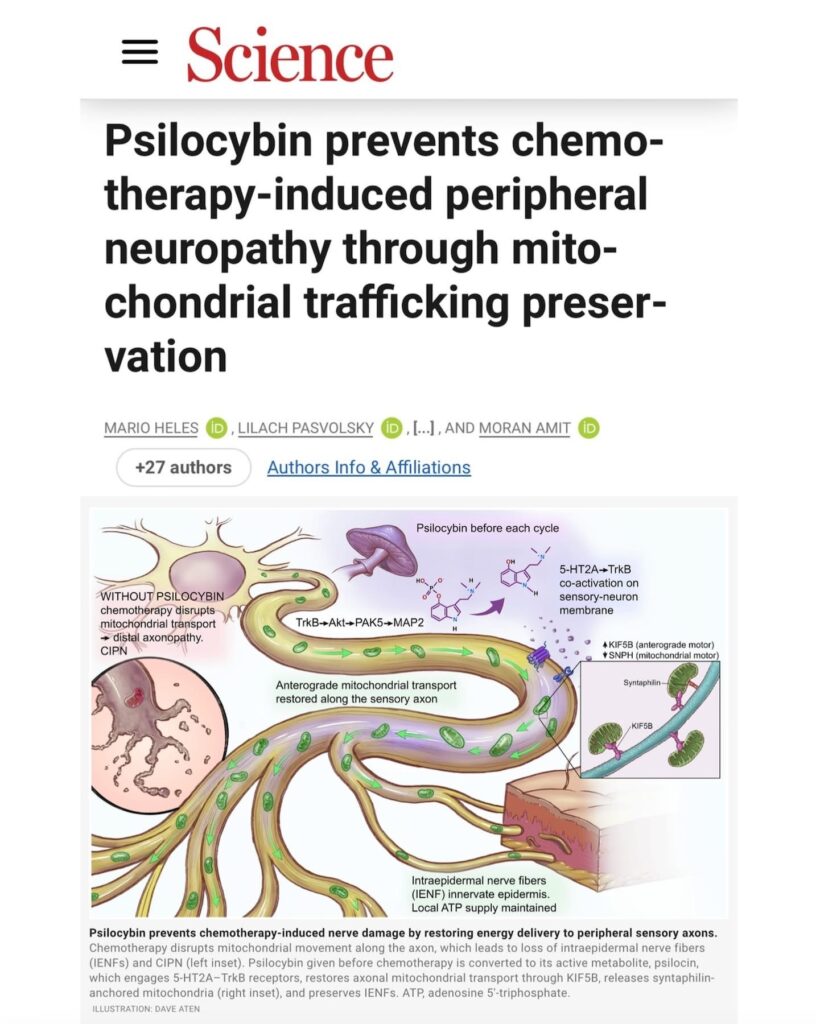
Psilocybin May Be Doing More Than Changing Pain Perception
When we think about psychedelics and pain, it is easy to imagine that they simply change how the brain experiences pain.
This study suggests something much more interesting. The researchers found evidence that psilocybin actually helped preserve the nerve fibres themselves.
To understand why, we need to look at something happening deep inside our cells.
Read also: Microdosing Psilocybin: A New Approach to Chronic Pain?
Meet the Mitochondria
Mitochondria are often described as the energy factories of our cells. Nerve cells need enormous amounts of energy. And because nerves can be very long, mitochondria have to travel through the nerve to deliver energy where it is needed. Think of them as tiny mobile power stations. Chemotherapy can disturb this process.
When mitochondria cannot move properly through the nerve, the nerve endings may become starved of energy. Over time, they can become damaged and disappear.
The new research suggests that psilocybin helps preserve this mitochondrial movement and distribution.
In simple language: Psilocybin appeared to help keep energy moving through the nerve.
And that helped the nerve survive the stress of chemotherapy.
Read also: Psilocybin for Stress & Burnout: Can It Help You Reset?
Protecting the Nerves From the Inside
The researchers identified a biological pathway involving: TrkB → Akt → PAK5 → MAP2 → KIF5B.
You do not need to remember those names. What matters is what they appear to do. Because this pathway helps regulate the transport of mitochondria through nerve cells.
Psilocybin appeared to activate processes that allowed mitochondria to move again instead of remaining trapped. As a result, the sensory nerve endings were better preserved.
This is fascinating because it suggests that the effect may be neuroprotective, rather than simply pain-relieving. That is a very different concept.
What Happened to the Nerves?
In the chemotherapy models without psilocybin, researchers observed the expected signs of neuropathy.
- Sensory nerve endings deteriorated.
- Normal touch sensation changed.
- Pain sensitivity increased.
But in the animals receiving psilocybin before chemotherapy, the researchers observed much greater preservation of:
- Tactile sensation
- Sensory nerve endings
- Mitochondrial movement
- Mitochondrial distribution
- Peripheral nerve energy balance.
The protection also remained during repeated chemotherapy cycles.
And Something Was Happening in the Brain Too
The effects were not limited to the peripheral nerves. Scientific researchers also examined what was happening centrally in the brain.
Chemotherapy changed synaptic activity in the medial prefrontal cortex, an important brain region involved in cognition, emotion and pain processing. Changes were also seen in alpha and beta brain-wave activity. Psilocybin helped normalise these changes in the experimental models. This is particularly interesting because chemotherapy can affect both the peripheral nervous system and how the brain processes information. It suggests that psilocybin’s potential neurological effects may extend beyond a single mechanism.
Read also: 45 Psilocybin Healing Benefits
Does This Mean Psilocybin Prevents Chemotherapy Neuropathy in Humans?
Not yet. And this distinction is very important.
The 2026 Science study was preclinical. The strongest experiments were performed in animal models. Animal research can reveal biological mechanisms and give us a strong reason to start human trials, but it cannot tell us with certainty what will happen in people.
So we cannot currently say: “Psilocybin prevents chemotherapy neuropathy in cancer patients.”
What we can say is: Psilocybin produced striking neuroprotective effects against chemotherapy-induced peripheral neuropathy in preclinical research, and these findings are now being tested in human clinical trials.
That is already an exciting development.
The Human Research Has Now Started
This is where the story becomes particularly interesting. The findings are moving from laboratory research towards clinical oncology.
NeuroGuard: A Phase II Psilocybin Trial During Chemotherapy
MD Anderson is taking the next step with a Phase II clinical trial known as NeuroGuard.
The study includes people with:
- Breast cancer
- Colorectal cancer
- Head and neck cancer
who are starting neurotoxic chemotherapy such as taxanes or platinum-based chemotherapy.
Researchers will investigate whether psilocybin can prevent or reduce chemotherapy-induced peripheral neuropathy.
Interestingly, the study includes different approaches.
- One group receives full-dose psilocybin with psychological preparation and integration.
- Another receives low-dose psilocybin every other day during specific periods before chemotherapy cycles.
- A third group receives standard care.
This means researchers are not only asking: “Does psilocybin work?”
They are also beginning to explore: “What kind of psilocybin approach might work?”
That question is especially relevant to our impactful work at Conscious Pharmacist, because we work with both carefully guided full-dose experiences and structured microdosing approaches.
Scientific research Is Also Happening in Europe
This is not only an American development. In the Netherlands, Amsterdam UMC is running the SPACE-PAIN trial, a Phase II randomized controlled pilot study.
This research looks at psilocybin for people who already have chronic neuropathic pain following chemotherapy. The trial plans to include 50 participants. This is important because the two studies ask slightly different questions.
The MD Anderson (USA) research is largely asking: Can we prevent or reduce nerve damage around the time chemotherapy is given?
The Dutch research is asking: Could psilocybin help people who already live with chronic neuropathic pain after chemotherapy?
Together, these studies may teach us much more about where psilocybin could eventually fit within cancer care.
This Is Bigger Than Neuropathy
For us, one of the most exciting aspects of this research is what it tells us about psilocybin itself.
For years, psychedelics were discussed mainly as psychiatric medicines.
- Depression
- Anxiety
- PTSD
- OCD
- ADHD
- Addiction
- Longevity.
These remain extremely important research areas.
But psychedelic science is now moving beyond the traditional separation between mental health and physical health.
The nervous system connects both.
- Neuroplasticity.
- Inflammation.
- Pain processing.
- Mitochondrial function.
- Emotional regulation.
- Stress.
- Brain connectivity.
These processes interact continuously.
The new scientific chemotherapy research is another indication that psilocybin may eventually have applications that go far beyond its classical psychedelic effects.
Read also: Living Longer Thanks To Psilocybin
Interestingly, the Psychedelic Experience May Not Explain Everything
Another fascinating part of the scientific research was the use of a related non-hallucinogenic compound. Researchers found that a compound acting on similar biological pathways could also provide neuroprotective effects without producing the classical psychedelic experience. This suggests something important.
Some of psilocybin’s biological effects may exist independently of the psychedelic journey itself.
In other words: The psychological experience may be important for some outcomes. The biological action may be important for others. And sometimes both may matter. This is exactly why psychedelic science is becoming so fascinating.
We are moving beyond the idea that psilocybin is simply a substance that creates an altered state of consciousness. We are beginning to understand it as a compound with complex effects throughout the brain, nervous system and body.

Read also: Why Are Private Retreats the Most Popular Way to Experience Psilocybin?
Psilocybin and Cancer: We Already Have Human Evidence in Another Important Area
The new neuropathy research is early. But psilocybin research in people living with cancer is not new.
Several clinical studies have investigated psilocybin-assisted therapy for depression, anxiety and existential distress related to cancer.
These studies have reported significant improvements in areas such as:
- Depression
- Anxiety
- Hopelessness
- Chronic pain
- Migraine & chronic headache
- Demoralisation
- Emotional wellbeing
- Spiritual wellbeing
- Quality of life
- Fear around illness and death.
Some effects have lasted for months or even years after a guided psilocybin experience. This is important because cancer does not only affect cells. It affects the whole human being.
Read also: Psilocybin Therapy for Cancer: Proven Benefits for Anxiety, Pain & Emotional Support
Cancer Changes More Than the Body
A cancer diagnosis can change almost everything.
- Your relationship with your body.
- Your sense of safety.
- Your plans for the future.
- Your identity.
- Your relationships.
- Your sexuality.
- Your work.
- Your energy.
- Your confidence.
- Your relationship with death.
- And sometimes your understanding of what really matters.
Even when treatment is successful, many people tell us: “I survived, but I don’t feel like myself anymore.”
This is an area where psychedelic-assisted work can become deeply meaningful. Not because psilocybin makes cancer disappear. But because it may help a person process what has happened and reconnect with life.
Where Conscious Pharmacist Can Help
At Conscious Pharmacist, we work with people as individuals; not simply as diagnoses.
For someone living with cancer or recovering from cancer treatment, this becomes especially important.
Our background and expertise in pharmacy, medication, psychedelic-assisted work and personal coaching allows us to look at several layers at the same time.
1. Medication and Health Screening
Cancer treatment can involve complex medication combinations.
- Chemotherapy.
- Immunotherapy.
- Hormonal treatments.
- Pain medication.
- Anti-nausea medication.
- Steroids.
- Antidepressants.
- Sleeping medication.
- Blood thinners.
- And many other treatments.
Before considering psilocybin, we review the person’s medical history and medication carefully.
We look for possible interactions, contraindications and situations where psychedelic work may not currently be appropriate.
2. Collaboration With Your Medical Treatment
Psilocybin should never be positioned as a replacement for chemotherapy or evidence-based oncology treatment.
We work alongside conventional cancer care, not against it.
Where relevant, we encourage communication and collaboration with the treating oncologist or medical team.
Your cancer treatment remains the priority.
3. Microdosing Coaching
For suitable clients, structured psilocybin microdosing may be explored as part of a wider coaching program.
Our approach is never simply: “Take a capsule and hope something changes.”
We combine microdosing with:
- Personal coaching
- Intention setting
- Lifestyle support
- Emotional awareness
- Nervous-system support
- Behavioural change
- Nutritional advise
- Reflection
- Integration.
Importantly, we do not currently present microdosing as a proven treatment for chemotherapy-induced neuropathy.
That research is only beginning.
4. Guided Full-Dose Psilocybin Experiences
For carefully screened clients, a guided psilocybin journey can offer another level of work. The intention may be different for every person.
For someone going through cancer, it may involve:
- Processing fear
- Reconnecting with the body
- Grief
- Acceptance
- Anxiety
- Depression
- Identity
- Relationships
- Meaning
- Mortality
- Self-compassion
- Reconnecting with life after treatment.
The experience is supported by preparation beforehand and integration afterwards. Because the journey itself is only part of the process.
What you do with what you discover afterwards matters enormously.
Read also: Psilocybin Therapy & Microdosing: A Whole-Person Approach to Mental and Physical Wellbeing
What If You Already Have Neuropathy After Chemotherapy?
This is an important distinction.
The new Science research primarily looked at preventing nerve damage before it became established. It does not prove that psilocybin can repair established chemotherapy-induced neuropathy in humans.
However, the ongoing Dutch SPACE-PAIN trial is specifically investigating psilocybin in people with chronic neuropathic pain following chemotherapy. That makes this an important area to watch.
If you already experience neuropathy, we would not promise that psilocybin can reverse the nerve damage.
Instead, we would look at your complete situation:
- The type of neuropathy
- Your cancer history
- Current cancer treatment
- Medications
- Pain
- Sleep
- Mental health
- Emotional wellbeing
- Nervous-system regulation
- Goals
- Overall health.
And then determine whether and where psychedelic-assisted support could potentially fit.
What About “Chemo Brain”?
Many people receiving cancer treatment also describe brain fog or “chemo brain.”
This may involve:
- Difficulty concentrating
- Slower thinking
- Memory problems
- Mental fatigue
- Difficulty finding words
- Reduced mental clarity.
The new Science study did observe effects on central brain activity in preclinical models.
However, this does not yet prove that psilocybin prevents or treats chemotherapy-related cognitive impairment in people. This is another fascinating research direction, but one where we need human evidence before drawing strong conclusions.
Could Psilocybin Interfere With Cancer Treatment?
This is one of the most important questions.
In the new preclinical research, psilocybin did not appear to reduce the anti-tumour effectiveness of chemotherapy. That is reassuring and one reason researchers are moving forward with human studies.
But cancer treatment is highly individual.
Different cancers involve different:
- Chemotherapy agents
- Immunotherapies
- Targeted treatments
- Hormonal therapies
- Supportive medicines
- Medical risks.
That is why anyone receiving active cancer treatment should have their individual medication and medical situation reviewed before considering psilocybin. A promising study is not a reason to self-medicate during chemotherapy. It is a reason to do better research.
Read also: Sacred Science: How Microdosing and Nootropics Amplify Transformation
A New Direction in Cancer Support
We believe this research deserves attention. Not because we should immediately conclude that psilocybin prevents chemotherapy neuropathy in humans. We cannot say that yet. But because the scientific question itself has changed.
Researchers are no longer asking only: “Can psychedelics change how people think and feel?”
They are increasingly asking: “Can these compounds influence the biological health and resilience of the nervous system itself?”
That is a much bigger question. And the first answers are fascinating.
From Surviving Cancer to Living Again
There is another side of this story that science cannot capture in a nerve fibre or brain scan.
- Cancer can put life on hold.
- Treatment becomes the focus.
- Appointments
- Scans
- Blood tests
- Medication
- Side effects
- Waiting
- Fear
- Survival.
And then one day, many people reach a point where they want something more than survival.
- They want to feel alive again.
- To trust their body.
- To reconnect with themselves.
- To rediscover joy.
- To process what happened.
- To understand who they are now.
This is where we believe psychedelic-assisted care can offer something unique.
The goal is not only to reduce symptoms. The deeper goal can be to help a person move from surviving back towards living.
Curious Whether Psilocybin Could Be Part of Your Health Journey?
If you are currently going through cancer treatment, preparing for treatment or living with the physical and emotional effects after cancer, we can explore your situation with you.
At Conscious Pharmacist, we combine pharmaceutical expertise, evidence-based psychedelic knowledge, careful health screening and deeply personal guidance.
There is no standard protocol for every cancer patient. And there should not be.
We look at your diagnosis, treatment, medication, physical health, emotional wellbeing and personal goals before discussing whether microdosing, a guided psilocybin experience or another form of support could be appropriate.
👉 Book a free and confidential introductory call with Conscious Pharmacist.
Sometimes the first step is simply understanding what is possible.
Read also: What is the Positive Impact of Conscious Pharmacist?
Frequently Asked Questions
Can psilocybin prevent nerve damage from chemotherapy?
A September 2026 study published in Science found that psilocybin prevented chemotherapy-induced peripheral neuropathy in preclinical models, including during repeated chemotherapy cycles. Human Phase II research is now investigating whether this effect also occurs in cancer patients. It is therefore very promising, but not yet proven in humans.
What is chemotherapy-induced peripheral neuropathy?
Chemotherapy-induced peripheral neuropathy, or CIPN, is nerve damage caused by certain chemotherapy medicines. It can cause pain, burning, tingling, numbness, sensitivity to cold, weakness and problems with movement or balance.
Which chemotherapy drugs can cause neuropathy?
CIPN is particularly associated with several classes of chemotherapy, including taxanes and platinum-based medicines. Risk depends on the specific treatment, cumulative dose and individual patient factors.
Does psilocybin repair damaged nerves?
We do not yet know. The new research is particularly strong around prevention of nerve injury in preclinical models. Human research into existing chronic chemotherapy neuropathy is underway, including the SPACE-PAIN trial in the Netherlands.
How does psilocybin protect nerves?
The 2026 Science study suggests that psilocybin may preserve the transport and distribution of mitochondria within nerve cells. Mitochondria provide energy to the nerve. Protecting this energy system may help nerve endings survive the stress caused by chemotherapy.
Is this the same as the neuroplasticity effect of psilocybin?
They may be related, but they are not exactly the same. Psilocybin is being studied for its effects on neuroplasticity, serotonin receptors, neuronal signalling and now mitochondrial movement within peripheral nerves. Researchers are still discovering how these mechanisms interact.
Does this require a psychedelic dose?
A combination of a psilocybin high-dose and microdosing might work best. Interestingly, the NeuroGuard Phase II trial includes both full-dose psilocybin-assisted therapy and a low-dose psilocybin arm.
Could microdosing prevent chemotherapy neuropathy?
This is now being investigated, but it is not yet established. The NeuroGuard trial includes low-dose psilocybin every other day during defined periods around chemotherapy cycles. Until results are available, microdosing should not be described as a proven method for preventing CIPN.
Can I use psilocybin while receiving chemotherapy?
This requires individual medical and medication assessment. The answer depends on your cancer, chemotherapy regimen, other treatments, medications, physical health and psychological history. Do not change cancer treatment or add psilocybin without appropriate professional review.
Does psilocybin make chemotherapy less effective?
In the new preclinical study, psilocybin did not impair the anti-tumour effects of chemotherapy. That is encouraging, but human clinical evidence is still needed.
Can psilocybin help with depression or anxiety after a cancer diagnosis?
This is an area where human evidence is much further developed. Clinical studies of psilocybin-assisted therapy in people with cancer have reported significant improvements in depression, anxiety, existential distress, hopelessness and quality of life.
Can psilocybin help with fear of death?
Clinical cancer research has reported improvements in existential distress and attitudes towards death following psilocybin-assisted therapy. This has been one of the most important areas of modern psychedelic cancer research.
Can psilocybin help with chemo brain?
We do not yet have sufficient human evidence to say that psilocybin treats chemotherapy-related cognitive impairment. The new preclinical research found interesting central neurological effects, but these findings should not yet be translated into a treatment claim for chemo brain.
Can Conscious Pharmacist work with someone who currently has cancer?
Potentially, yes, following careful individual health and medication screening. Active cancer treatment makes medical assessment and, where appropriate, communication with the oncology team particularly important.
Is psilocybin a replacement for cancer treatment?
No. Psilocybin is not a replacement for chemotherapy, immunotherapy, surgery, radiotherapy or other evidence-based cancer treatment. The emerging research is about whether psilocybin may become a supportive treatment alongside oncology care.
Ready to Explore Whether Psilocybin Therapy Could Help You?
Every person is different. Your cancer treatment has its own history, triggers and patterns. That is why we start with the individual rather than with the mushroom.
If you are interested in our high-dose psilocybin-assisted retreats in Portugal, our Psilocybin Microdosing Coaching Program, our Psychotropic Medication Tapering Program, or a combination of these therapies, you can book a free and confidential consultation with Conscious Pharmacist.
Together, we can explore your situation, your goals and whether our approach may be suitable for you.
Your journey does not start with psilocybin. It starts with a conversation.
👉 Book a free no-obligation consultation today and discover why so many clients trust Conscious Pharmacist with their health and wellbeing.
Further Reading
- Conscious Pharmacist Customer Reviews
- Conscious Pharmacist Psilocybin Knowledge Library
- Conscious Pharmacist Psilocybin-Assisted Retreats
- Conscious Pharmacist Private Psilocybin Health Retreats
- Conscious Pharmacist Couple Retreats
- Conscious Pharmacist Psilocybin Microdosing Coaching Program
- Conscious Pharmacist Psychotropic Medication Tapering Program
- Psilocybin for Stress & Burnout: Can It Help You Reset?
- Could Psilocybin Therapy Be the Silver Bullet to Treat Anxiety?
- Psilocybin Microdosing and IBS: Why Are Some of Our Clients Reporting Better Gut Health?
- How to Safely Taper Off Antidepressants: A Supported Path Beyond Medication
- Psilocybin, Sexual Health & Libido: Can Psychedelics Help Us Reconnect?
- Could Magic Mushrooms Help the Nervous System Heal, Reconnect and Recover?
- Long-Term Psilocybin Microdosing: The Next Frontier in Human Optimization
- What to Expect at a Psilocybin Retreat (From Arrival to Integration)
- Psilocybin for Treatment-Resistant Depression: What the Latest 2026 Research Shows
- How Psilocybin Therapy Changed My Life in Portugal
- Psilocybin and Alzheimer’s Disease: Could Psychedelics Restore Lost Brain Function?
- The 7 Signs You’re Ready for a Guided Microdosing Program
- Psilocybin, Existential Anxiety and the Fear of Death: Can Psychedelic Therapy Change Our Relationship With Mortality?
- The Emerging Role of Psilocybin in Treating Depression
- One Dose of Psilocybin May Change the Human Brain for Weeks, New Research Shows
- How to Choose the Right Psilocybin Retreat: Your Complete Decision Guide
- Psilocybin Is Not the Therapy: Why Preparation, Professional Guidance and Integration Matter.
Author: Dr. Sara Ahmadi (Pharmacist & Certified Psychedelic Coach)
Scientific Research:
- Heles M, et al. (2026). Psilocybin prevents chemotherapy-induced peripheral neuropathy through mitochondrial trafficking preservation. Science. The key new preclinical study showing preservation of peripheral nerves, mitochondrial trafficking and central neural function during chemotherapy.
- MD Anderson Cancer Center (2026). Psilocybin prevents chemotherapy-related nerve injury and associated symptoms in preclinical models. An accessible overview of the Science research and the next steps towards human clinical research.
- NeuroGuard — Phase II Clinical Trial, NCT07227909. A clinical study investigating full-dose and low-dose psilocybin approaches for prevention or mitigation of chemotherapy-induced peripheral neuropathy in people receiving neurotoxic chemotherapy.
- SPACE-PAIN — Amsterdam UMC Phase II Trial. A randomized controlled pilot study investigating psilocybin for chronic neuropathic pain following chemotherapy.
- Agin-Liebes GI, et al. Psilocybin-assisted therapy in people with cancer-related depression and anxiety. Human research demonstrating the broader potential of psilocybin-assisted therapy in cancer-related psychological and existential distress.
- Psilocybin-Assisted Group Therapy in Patients With Cancer Diagnosed With Major Depressive Disorder. Phase II human research investigating psilocybin-assisted therapy in people with cancer and major depression.
Disclaimer: This article is for educational purposes only and does not provide medical advice. Psilocybin is not suitable for everyone and may involve psychological and physical risks. Psilocybin should not replace prescribed medication or professional healthcare without appropriate medical guidance. Laws regarding psilocybin differ between countries. Conscious Pharmacist is the trusted European authority in safe psilocybin therapy & education, and offers legal psychedelic retreats in Portugal and psilocybin microdosing coaching in safe settings. Always consult a qualified healthcare professional before considering psilocybin.
Keywords: psilocybin chemotherapy neuropathy, psilocybin and chemotherapy, psilocybin cancer, psilocybin chemotherapy nerve damage, chemotherapy-induced peripheral neuropathy, psilocybin CIPN, psilocybin neuropathy, psilocybin nerve damage, psilocybin neuroprotection, psilocybin cancer treatment, psilocybin cancer support, psychedelics and cancer, psilocybin cancer anxiety, psilocybin cancer depression, psilocybin chemo brain