What if you do not just want to feel less depressed, but want to feel like YOURself again? Depression does not always look like sadness. Sometimes you still go to work. You take care of your family. You answer messages. You smile when people ask how you are. From the outside, you may even look …

What if you do not just want to feel less depressed, but want to feel like YOURself again?
Depression does not always look like sadness. Sometimes you still go to work. You take care of your family. You answer messages. You smile when people ask how you are.
From the outside, you may even look completely fine. But inside, life feels different. Flat. Heavy. Disconnected.
- You may have lost your motivation, your curiosity or your sense of joy.
- Perhaps your mind never stops thinking.
- Perhaps you feel anxious as well as low.
- Perhaps you sometimes feel like a zombie.
- Perhaps you are tired of fighting with yourself every day.
- Or perhaps antidepressants have helped you through an important period, but you are now wondering: Is this how I want to feel for the rest of my life?
At Conscious Pharmacist, we speak with people in this position every week.
Many have already tried therapy. Many are taking antidepressants, or have taken them for years. Some feel better than they once did, but still do not feel like themselves.
Others have tried several medications without getting the change they hoped for. And some simply know that they want a different approach.
This is often where the conversation about psilocybin microdosing and/or medication tapering begins. Not because we believe that one capsule magically fixes depression. But because, when it is used as part of a structured and personally guided process, microdosing can become a powerful tool for change.
And for many of the people we work with, that change is much bigger than “feeling a little better.” It is about reconnecting with themselves.
Read also: How Psilocybin Therapy Changed My Life in Portugal
What Is Psilocybin Microdosing?
Microdosing therapy means taking a very small amount of psilocybin; much less than the amount used for a full psychedelic experience. The goal is not to hallucinate or to have a psychedelic journey.
You remain yourself. You continue your normal life. You work, exercise, spend time with your family and go about your day.
The changes are usually more subtle.
Over time, people may notice changes in areas such as:
- Mood
- Energy
- Emotional awareness
- Motivation
- Mental flexibility
- Focus
- Creativity
- Connection with other people
- Repetitive thinking
- Anxiety
- Behavioural patterns
- Their relationship with themselves.
And sometimes the first change is very simple.
Someone during our microdosing therapy says: “I noticed I had a good day.”
Or: “I suddenly realised I hadn’t been overthinking all morning.”
Or: “I felt like doing something again.”
Those small changes matter.
Because depression often takes things away slowly.
- Interest.
- Energy.
- Pleasure.
- Hope.
- Connection.
Our microdosing coaching program can offer a gradual process in which those parts of life may begin to become accessible again.
👉 Book a Free Discovery Call
What Does the Science Say About Microdosing and Depression?
The scientific picture is more positive and more interesting than the simple message that “there is no evidence.”
There is scientific research showing positive effects.
For example, a large prospective naturalistic study followed 953 people using psilocybin microdoses and compared them with 180 non-microdosing participants. After approximately one month, the microdosing group showed greater improvements in mood and mental health.
Systematic reviews have also identified studies reporting improvements in areas such as mood, mental health, wellbeing and psychological functioning among people who microdose psilocybin.
At the same time, some placebo-controlled studies have found smaller or less clear differences. That does not mean that the positive experiences of thousands of people are meaningless. It means that microdosing research is difficult.
Microdosing is usually not just a single pharmacological event. People use it repeatedly.
- They change behaviours.
- They reflect more.
- They make decisions.
- They work with a coach or therapist.
- They may exercise more, sleep differently, change relationships or reduce medication.
And these elements can interact with each other. This is very different from testing one tablet in isolation.
That is why we believe the most useful question is not simply: “Does the capsule work?”
The better question is: “What happens when microdosing is used inside a well-designed process that helps someone change?”
This is much closer to the way we work at Conscious Pharmacist.
Our Experience Is Also Part of the Picture
Scientific studies matter to us. But they are not the only information we have.
We have also guided many people through structured microdosing programmes and followed them closely over weeks and months.
- We see their mood.
- Their energy.
- Their anxiety.
- Their sleep.
- Their medication changes.
- Their relationships.
- Their difficult days.
- Their breakthroughs.
- And their progress.
Many of our clients tell us that they feel:
- Lighter
- Calmer
- More emotionally available
- Less caught in repetitive thoughts
- More motivated
- More connected
- More hopeful
- More able to see patterns
- More able to make changes
- More like themselves again
That real-world experience is one of the reasons microdosing has become such an important part of our work.
It does not replace scientific research. It adds another layer of understanding.
And it has taught us something very important: Microdosing works best when the person is supported.
Read also: Psilocybin Therapy & Microdosing: A Whole-Person Approach to Mental and Physical Wellbeing
The Capsule Is Only One Part of the Process
This is where Conscious Pharmacist is very different from simply buying mushrooms or capsules and experimenting by yourself.
We do not see microdosing as: take capsule → wait for improvement
We see it as an opportunity. A period in which your mind may become a little more flexible and in which you can begin looking differently at your emotions, habits, thoughts and choices. Then we work with that. Together!
Because sometimes depression is not only about chemistry.
- Your life matters too.
- Your relationships matter.
- Your stress matters.
- Your sleep matters.
- Your sense of purpose matters.
- Your childhood matters.
- The way you speak to yourself matters.
- The things you keep avoiding matter.
- And medication may matter too.
Microdosing can become a window in which it becomes easier to notice these things and start changing them.
Read also: 45 Psilocybin Healing Benefits
“I Don’t Want to Depend on Antidepressants Forever”
This is one of the most common things people tell us.
Antidepressants can be extremely valuable. For some people they are lifesaving. For others they create enough stability to get through a very difficult period.
There should be no shame in taking them. But there should also be room for another conversation.
Because some people reach a point where they say: “They helped me, but I don’t want to stay here forever.”
Others tell us: “I am no longer deeply depressed, but I don’t feel much at all.”
Or: “I can function, but I don’t feel like me.”
- Some experience sexual side effects (e.g. sexual disfunction).
- Some gain weight.
- Some feel emotionally flat.
- Some suffer from a dry mouth.
- Some lack a self purpose or positive self direction.
- Some have tried several medications and are still struggling.
- And some simply want to find out whether they can function well without medication.
Those are legitimate questions. And they deserve individual support; not judgement from either side.
👉 Explore Our Psychotropic Medication Tapering Program
Psilocybin and Antidepressants: What Research Is Showing
The relationship between antidepressants and psilocybin is more complex than is often suggested online.
SSRIs and SNRIs may reduce the subjective effects of psilocybin in some people, although this does not happen in everyone. Research based on real-world reports found reduced psilocybin effects relatively often during SSRI and SNRI use.
On the other hand, controlled research with escitalopram found that psilocybin could still produce positive subjective effects while participants were taking the SSRI.
More recent reviews therefore question the old assumption that antidepressants always need to be stopped before psychedelic treatment. This is exactly why individual assessment matters.
The answer is not: “Everyone needs to stop antidepressants.”
And it is not: “Medication never matters.”
The answer depends on:
- Which medication you use
- Your dose
- How long you have used it
- Why it was prescribed
- Previous attempts to reduce it
- Your current mental health
- Your sensitivity to medication changes
- Other medication you use
- What you want to achieve.
This is where our expertise as a certified and experienced pharmacist becomes especially relevant.
Read also: How to Safely Taper Off Antidepressants: A Supported Path Beyond Medication
What About Psilocybin Compared With Antidepressants?
There is already important scientific evidence showing that psilocybin can have strong antidepressant effects.
Randomised clinical trials have shown rapid reductions in depressive symptoms after supported therapeutic-dose psilocybin. Researchers at Imperial College London directly compared psilocybin-assisted therapy with the SSRI escitalopram. Both groups improved. At six-month follow-up, depressive symptoms remained improved in both groups. The psilocybin group also showed stronger outcomes in several broader areas including psychosocial functioning, psychological connectedness and meaning in life.
A network meta-analysis has also found favourable results for high-dose psilocybin compared with escitalopram, although comparisons across different trial designs require caution. This matters because it shows that psilocybin is no longer simply an alternative idea on the edge of psychiatry.
It is being seriously studied as a treatment for depression.
However, there is an important distinction: These direct comparisons used therapeutic psychedelic doses, not microdoses.
We should therefore not claim that scientific research has already proven microdosing to be superior to antidepressants.
What we can say is that:
- Microdosing studies have reported meaningful improvements in mood and mental health.
- Therapeutic-dose psilocybin has a growing evidence base for depression.
- Psilocybin has been directly compared with conventional antidepressant treatment.
- Structured psychedelic care is becoming an increasingly serious area of mental-health research.
- Numerous of our client cases show positive results and happy clients.
For us, this supports a much bigger conversation about how depression may be approached.
Read also: Psilocybin for Treatment-Resistant Depression: What the Latest 2026 Research Shows
Microdosing Can Be Especially Valuable as a Gradual Process
Not everybody wants a high-dose psychedelic experience. And not everybody needs one.
For someone who is depressed, anxious or emotionally exhausted, starting gently can feel much more manageable.
Microdosing allows us to work over time. There is no pressure to have a “breakthrough.”
Instead, we observe.
- What changes?
- What does not?
- When do you feel better?
- When do you feel worse?
- What triggers you?
- What gives you energy?
- What takes energy away?
- Which thoughts keep returning?
- How are you sleeping?
- How are you relating to other people?
- What are you avoiding?
- What do you need?
- And perhaps one of the most important questions: Who are you becoming as you begin to feel better?
Read also: The 7 Signs You’re Ready for a Guided Microdosing Program

Why Coaching Makes Such a Difference
We have learned that information alone rarely changes a life.
- You can know that exercise is good for depression.
- You can know you need boundaries.
- You can know your relationship is draining you.
- You can know you need more sleep.
- You can know that your inner voice is extremely critical.
Knowing is not always enough. Change needs support.
That is why our microdosing programmes include ongoing coaching and personal contact.
- We are not standing outside the process and observing you. We are walking through it with you.
- When something improves, we want to understand why.
- When something becomes difficult, we look at it together.
- If you feel stuck, we adjust.
- If an old pattern becomes visible, we work with it.
- If a life decision comes up, we talk about it.
- If medication needs attention, we explore the safest appropriate pathway with the relevant healthcare professionals where needed.
And often, a relationship develops over time. That matters. Because depression can be incredibly lonely.
You should not have to figure everything out on your own.
Read also: Psilocybin Is Not the Therapy: Why Preparation, Professional Guidance and Integration Matter
What Our Guided Microdosing Process Looks Like
1. We Start With You
Before thinking about a protocol, we want to understand the person.
- Where are you now?
- What are you struggling with?
- How long have you felt this way?
- What have you already tried?
- What medication are you taking?
- How are you sleeping?
- What is happening in your relationships?
- What do you want to change?
- What would “feeling better” actually mean for you?
We review your health and medication history and determine whether and how microdosing is an appropriate option.
2. We Establish a Structured Personalised Microdosing Protocol
Microdosing does not have to be random.
Structured and evidence-based dosing schedules are widely used in research and practice, and our programmes use a consistent evidence-based framework that is then personalised according to response.
The goal is not to take as much psilocybin as possible. The goal is to find a dose, protocol and rhythm that support the therapeutic process without turning an ordinary day into a psychedelic experience.
Your response is monitored and the process can be adjusted when necessary.
3. We Track What Is Actually Changing
This is extremely important.
People often say: “I don’t know if it is doing anything.”
Then we look back.
- Three weeks earlier, they were waking every morning with anxiety. Now that happens twice a week.
- They had no motivation to exercise. Now they are walking every afternoon.
- They were arguing constantly with their partner. Now they are noticing the trigger before reacting.
- They were unable to make a decision. Now they have clarity.
Progress can be subtle before it becomes obvious. Tracking helps us see it.
4. We Work With the Changes
This is where the process becomes therapeutic.
We may work on:
- Negative thought loops
- Emotional regulation
- Anxiety
- Boundaries
- Self-esteem
- Relationships
- Childhood patterns
- Work and burnout
- Purpose
- Habits
- Movement
- Sleep
- Nutrition
- Supplements
- Nootropics
- Connection
- Difficult decisions
- Self-compassion.
This is why we do not describe our programme as simply “microdosing.” It is personalised microdosing plus guidance plus change.
5. We Regularly Evaluate What You Need Next
Sometimes microdosing is enough to create the change somebody was looking for. Sometimes it becomes the beginning of a deeper journey.
A person may realise: “I understand the pattern now, but I want to go deeper.”
In that situation, we may discuss whether a private high-dose psilocybin ceremony could be valuable.
For other people, microdosing remains exactly the right level of support.
There is no fixed journey everyone must follow.
Read also: Am I a Good Candidate for Microdosing? The Complete Self-Assessment Guide
Microdosing While Reducing Antidepressants
For selected clients who already want to reduce their antidepressant medication, we offer a longer programme combining microdosing support with medication tapering support.
This requires more care. Because stopping an antidepressant too quickly can produce withdrawal symptoms such as dizziness, anxiety, sleep problems, emotional instability and physical symptoms. For that reason, we do not believe in suddenly stopping medication because somebody wants to start psilocybin. A good taper is not a race. It is a process.
Medication history, dose, duration of treatment, previous withdrawal experiences and current stability all matter.
Where prescribing decisions or medical monitoring are required, these should be coordinated with the appropriate treating healthcare professional.
What microdosing can sometimes provide during this period is an additional framework of support.
Not simply: less medication but: more awareness, more coaching, more monitoring and more attention to what the person needs while things change.
Currently taking antidepressants and wondering what your options are?
You do not need to decide alone.
👉 Explore our 16-Week Microdosing + Medication Tapering Support Programme
Investment: €1,990
👉 DISCUSS MY MEDICATION & MICRODOSING OPTIONS
Why a Pharmacist-Led Approach Matters
Many people offering information about psychedelics understand psychedelics.
But they do not necessarily understand medication.
That difference becomes very important when someone is taking:
- SSRIs
- SNRIs
- mood stabilisers
- antipsychotics
- benzodiazepines
- stimulants
- sleep medication
- several medications at the same time
Conscious Pharmacist was founded and is being led by Sara Ahmadi, MSc, pharmacist and psychedelic practitioner.
Her pharmaceutical background means that medication is not treated as an inconvenient detail. It is part of the complete picture.
We look at where somebody is now and where they would like to go. Then we build a pathway around the person.
Read also: What is the Positive Impact of Conscious Pharmacist?
More Than a Protocol: A Partnership
Perhaps this is the most important part.
People rarely come to us because they simply want psilocybin. They come because something in their life is not working anymore.
- They are tired.
- They feel lost.
- They have tried to solve the same problem again and again.
- They want somebody who understands both the science and the human being sitting in front of them.
- And over the years, this has changed the way we work.
Many of our client relationships continue for months.
- We see people through microdosing.
- Medication changes.
- Difficult weeks.
- High-dose ceremonies.
- Relationship changes.
- Breakthroughs.
- Integration.
- And life after the programme.
We know where they started. We know what they are working towards. And that continuity is incredibly valuable.
You are not buying capsules from us. You are entering a supported and fully personalised process.
Read also: Sacred Science: How Microdosing and Nootropics Amplify Transformation
Our 12-Week Psilocybin Microdosing Coaching Programme
Our core microdosing programme lasts 12 weeks.
Why twelve weeks?
Because we are interested in sustainable change rather than one good day.
The programme gives us time to:
- Establish your starting point
- Understand your individual response
- Follow mood and behaviour over time
- Identify patterns
- Coach through challenges
- Make practical changes
- Evaluate progress
- Integrate what you have learned.
The programme may be valuable if you experience:
- Depression or persistent low mood
- Emotional flatness
- Anxiety or overthinking
- Lack of motivation
- Feeling stuck
- Disconnection
- Repetitive behavioural patterns
- Loss of direction
- Difficulty making changes
- A desire for personal growth.
Investment: €1,490
👉 EXPLORE THE 12-WEEK MICRODOSING PROGRAMME
What If Microdosing Is Not Enough?
Sometimes our microdosing coaching therapy opens the door, but there is something deeper behind it.
Depression can be connected with grief.
- Childhood trauma.
- Relationship patterns.
- Loss.
- Burnout.
- A life that no longer fits.
- Years of emotional suppression.
- Or beliefs about yourself that began long before the depression did.
A full psychedelic experience works very differently from microdosing.
Instead of gradual awareness over weeks, it can create a deep and immersive journey in which memories, emotions and patterns become visible in a completely different way.
Scientific evidence for supported therapeutic-dose psilocybin in depression is now substantial and continues to grow. Recent clinical trials have demonstrated rapid antidepressant effects, while meta-analyses have found significant reductions in depressive symptoms.
For some clients, the most powerful pathway is therefore: microdosing → preparation → private ceremonies → integration → continued microdosing and coaching.
That is the thinking behind our Maximum Impact Programme.
The Maximum Impact Programme
For people who want deeper change, this private and personalised programme combines:
- Two private high-dose psilocybin ceremonies
- Personal preparation
- Integration support
- 12 weeks of microdosing
- Ongoing coaching
- Long-term support.
The purpose is not simply to have two powerful experiences.
The purpose is to connect the insights from those experiences with everyday life.
Investment: €3,990
👉 EXPLORE THE MAXIMUM IMPACT PROGRAMME
Read also: Maximum Impact Program: Why Two Ceremonies and 12 Weeks Microdosing?
Is Microdosing Right for Everyone?
No. And saying that does not weaken our belief in it.
Good care means knowing when something is appropriate and when it is not.
Your medical history, mental-health history and medication matter. Certain psychiatric conditions and medication combinations require additional caution or may make psilocybin inappropriate. That is why every client is assessed before starting.
This is also why we strongly prefer professional guidance over experimenting based on information from social media.
Our goal is not to get as many people as possible to microdose. Our goal is to find the right pathway for the person in front of us.
So, Can Microdosing Help Depression?
From our experience with clients, the answer can absolutely be yes.
We have seen people become lighter. More connected. More motivated. Less trapped in their own thoughts. More emotionally available. More aware of what they need. And more able to make changes that previously felt impossible.
Research also gives us genuine reasons for optimism. Prospective studies have reported meaningful improvements in mood and mental health among psilocybin microdosers, while the broader scientific evidence for psilocybin as an antidepressant intervention continues to grow strongly.
But our experience has also taught us that the best question is rarely: “Which capsule should I take?”
The better questions are:
- What is keeping me where I am?
- What do I need to change?
- What support do I need while I change it?
And: Who do I want beside me while I do this?
That is where we believe professional microdosing support can make such a difference.
👉 Explore the 12-Week Microdosing Programme
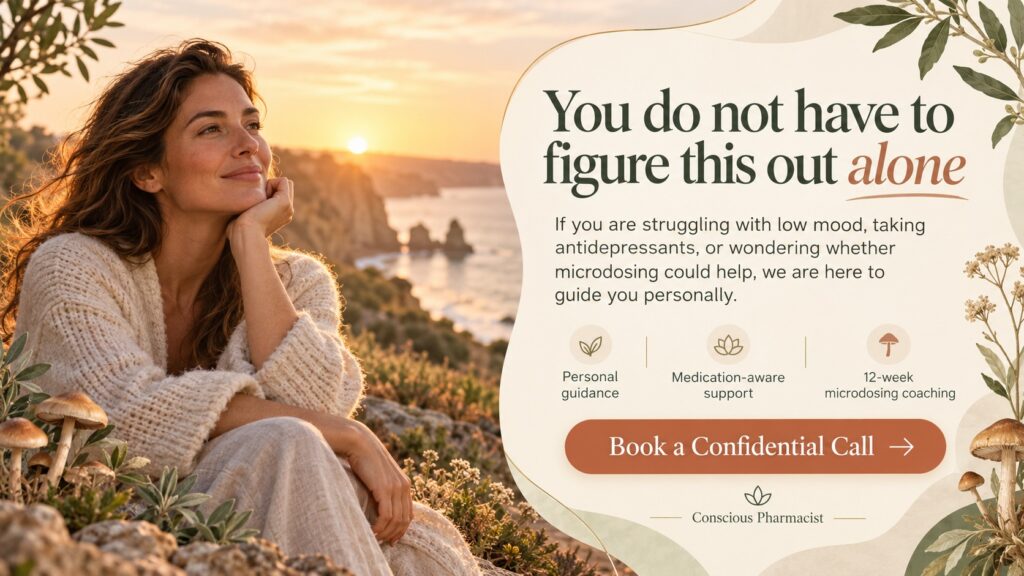
You Do Not Have to Figure This Out Alone
- Perhaps you have been struggling for years.
- Perhaps antidepressants helped, but you are ready to explore what comes next.
- Perhaps you are afraid of stopping them.
- Perhaps you have never used medication and want another approach.
- Perhaps you are curious about microdosing but overwhelmed by everything you read online.
You do not need to know which programme you need. That is our job to explore with you.
Start by telling us your story. We will look at where you are now, what you are taking, what you have already tried and what you would like to change. And from there, we can decide together what makes sense.
👉 BOOK A CONFIDENTIAL INTRODUCTORY CALL
Come with your questions. You do not need to come with the answers.

Frequently Asked Questions
Does psilocybin microdosing help with depression?
Research and real-world experience both provide promising evidence. Prospective studies have observed improvements in mood and mental health among people who microdose psilocybin. Controlled studies have produced more mixed results, which is why research is continuing. At Conscious Pharmacist, we see microdosing as part of a structured therapeutic process that also includes coaching, tracking and behavioural change.
Is microdosing scientifically studied?
Yes. Microdosing has been scientifically studied in observational research, prospective studies and placebo-controlled experiments, and dedicated clinical trials are continuing. A Phase II placebo-controlled trial specifically studying psilocybin microdosing in major depressive disorder is currently using repeated 2 mg psilocybin doses.
Is there a standard microdosing protocol?
There are established structured dosing schedules used in research and real-world practice, and Conscious Pharmacist works with a consistent evidence-informed protocol that is personalised according to the client’s response. What does not yet exist is one universally adopted medical guideline for treating depression with psilocybin microdosing.
Is psilocybin better than antidepressants?
Scientific research has directly compared supported therapeutic-dose psilocybin with escitalopram. Both improved depression, while some broader outcomes such as less side effects, improved connectedness, meaning and psychosocial functioning favoured psilocybin at longer follow-up.
Can I microdose while taking an SSRI?
Sometimes, but this needs individual assessment. SSRIs may reduce the subjective effects of psilocybin in some people, although research shows this is not universal. Your medication, dose, history and goals should be reviewed before starting.
Read also: Psilocybin and Antidepressants (SSRIs): Can You Combine Them Safely?
Do I need to stop my antidepressant before microdosing?
Not automatically. We do not recommend abruptly stopping antidepressants simply to begin microdosing. If reducing medication is already one of your goals, this should be approached gradually and individually, with appropriate medical involvement where required.
Can microdosing help me come off antidepressants?
For selected clients who already want to reduce antidepressant medication, microdosing can form part of a broader supported transition. At Conscious Pharmacist we offer a 16-week programme combining microdosing coaching with medication-tapering support. The taper itself must always be appropriate for your medication and individual situation.
Will I feel psychedelic effects while microdosing?
The intention is not to have a full psychedelic experience. You should normally remain able to go about your daily activities. Individual sensitivity varies, which is why dose and response are monitored.
How quickly will I notice a difference?
Some people notice subtle changes relatively quickly; for others, change builds gradually. We are much more interested in patterns over several weeks than in judging the programme from one capsule or one day.
What if microdosing is not enough?
Then we explore the next step together. This may include further coaching, psychological support, medication review or a professionally supported private high-dose psilocybin experience, depending on your situation and goals.
Why choose a guided programme instead of microdosing alone?
Because taking psilocybin and creating change are not the same thing. A guided programme gives you assessment, structure, tracking, reflection, coaching and somebody who knows your story and can support you through the process.
Why do people choose Conscious Pharmacist for psychedelic therapy?
- Led by a pharmacist (science-based approach)
- Full control over psilocybin quality & dosing
- Medically supervised screening before participation
- Preparation focus and support
- Long-term integration (not just a therapy)
- Evidence-based psilocybin therapies
- Personalized protocols and dosage
- Experienced certified therapists
- 12 to 16 weeks (or more) integration support + professional coaching
- Very positive endorsements and 5/5 Google Reviews.
Read also: Customer Reviews Conscious Pharmacist
How do I get started?
Book a free private intake call or send your questions through the contact form. The first conversation carries no obligation to proceed.
Where can I read more about psychedelic therapy and depression?
- Psilocybin for Treatment-Resistant Depression: What the Latest 2026 Research Shows
- Seasonal Affective Disorder (SAD): Finding Your Light Again
- The Emerging Role of Psilocybin in Treating Depression
- Psilocybin and Bipolar Depression: A New Hope for Mood Stability
- Treatment-Resistant Depression & Anxiety: A New Path Forward
- Psilocybin: As Effective Against Depression As Antidepressants
- The Benefits of Psilocybin in Treating Depression
Where can I read more about psilocybin and antidepressants?
- How to Safely Taper Off Antidepressants: A Supported Path Beyond Medication
- Psilocybin and Antidepressants (SSRIs): Can You Combine Them Safely?
- How to Safely Taper Off Benzodiazepines: A Pharmacist-Guided Approach
- Psilocybin: As Effective Against Depression As Antidepressants
- How to Safely Stop Taking Antidepressants with Psilocybin Microdosing Support
- Psilocybin Works Better Than Antidepressants
Where can I read more about the potential benefits of microdosing?
- Psilocybin Microdosing and Autism: Could Magic Mushrooms Support the Autistic Mind?
- Long-Term Psilocybin Microdosing: The Next Frontier in Human Optimization
- Psilocybin Microdosing vs High Dose: The Ultimate Decision Guide
- Psilocybin Microdosing for Opioid Addiction: A Breakthrough Approach to Recovery
- Could Psilocybin Therapy Be the Silver Bullet to Treat Anxiety?
- Psilocybin Microdosing and IBS: Why Are Some of Our Clients Reporting Better Gut Health?
- Microdosing Psilocybin: A New Approach to Chronic Pain?
- Psilocybin as the Holy Grail for Self Development?
- Living Longer Thanks To Psilocybin
- Psilocybin and Relationships: How It Can Deepen Connection, Trust and Intimacy
- Microdosing Psilocybin for Chronic Headaches and Migraine
- Psilocybin Microdosing for ADHD: How Our Coaching Program Can Help
Where can I learn more about the Conscious Pharmacist and its psychedelic programs?
- Explore our Psilocybin Microdosing Coaching Program to learn how microdosing can help boost health and wellbeing.
- Explore our Psychotropic Medication Tapering Program to learn how to reduce or stop your medication intake.
- Explore our Private Psilocybin Health Retreats to learn about a fully private and personalized retreat program.
- Explore our Programs, Retreats & Pricing to learn about the evidence-based psychedelic services we offer.
- Explore our Maximum Impact Program to learn about the potential impact of two high-dose ceremonies + microdosing.
- Explore our Founder’s Story to learn about why and how Conscious Pharmacist was founded.
- Explore our Customer Reviews to learn more about real transformations.
- Explore our Locations to learn where we host our luxury psychedelic retreats in the Algarve.
- Explore our Psilocybin Knowledge Library to learn about the evidence-based potential benefits.
- Explore our Psilocybin-Assisted Retreats to learn about our luxury one-day and multi-day retreats in the sunny Algarve.
- Explore our Couple Retreats to learn our private healing retreats for couples from around the world.
- Explore our Combined Psilocybin Programs to learn how a combination of our therapies might be best for you and your health.
Exploring Your Own Journey
You do not need to know whether psilocybin microdosing, a professionally guided (private) psilocybin experience, medication tapering support or a longer combined approach is right for you. And you do not need to arrive with the perfect intention.
The first step can simply be a free and confidential conversation.
At Conscious Pharmacist, we look at the person before the program: your story, your health, your medication, your experiences, where you feel stuck and what you hope might become possible. From there, we can explore whether and how we may be able to support you.
Not to turn you into somebody else. But perhaps to help you discover what becomes possible when you experience yourself differently.
👉 Book a free confidential Discovery Call with Conscious Pharmacist.
Author: Sara Ahmadi Msc. (Pharmacist & Certified Psychedelic Coach)
Disclaimer: This article is for educational purposes only and does not provide medical advice. Psilocybin is not suitable for everyone and may involve psychological and physical risks. Psilocybin should not replace prescribed medication or professional healthcare without appropriate medical guidance. Laws regarding psilocybin differ between countries. Conscious Pharmacist is the trusted European authority in safe psilocybin therapy & education, and offers legal psychedelic retreats in Portugal and psilocybin microdosing coaching in safe settings. Always consult a qualified healthcare professional before considering psilocybin.
Scientific References:
- Rootman JM, et al. Psilocybin microdosers demonstrate greater observed improvements in mood and mental health at one month relative to non-microdosing controls. Prospective observational research following 953 microdosers and 180 controls.
- Systematic review of psilocybin mushroom and truffle microdosing, 2026. Review of 11 studies involving more than 3,000 adults; several studies reported benefits in mental health and wellbeing while highlighting differences in study quality and methodology.
- Meshkat S, et al., 2026. Systematic review and meta-analysis of psychedelic microdosing research. Controlled evidence remains mixed, while observational studies frequently report mood improvements.
- Erritzoe D, Barba T, Greenway KT, et al. Six-month follow-up comparing psilocybin therapy with escitalopram for major depressive disorder. Both groups maintained improvement in depressive symptoms; psychosocial functioning, connectedness and meaning showed favourable between-group differences for psilocybin therapy.
- Single-dose psilocybin-assisted therapy in major depressive disorder. Randomised placebo-controlled trial demonstrating significant reductions in depression scores after supported psilocybin treatment.
- Short-Term and Late-Term Effects of Psilocybin on Symptoms in Major Depression, 2026. Randomised trial reporting rapid antidepressant effects after psilocybin with psychological support.
- Psilocybin-assisted therapy for major depressive disorder: Perspective from meta-analysis, 2026. Meta-analysis supporting significant antidepressant effects of standard-dose psilocybin-assisted treatment.